Social Aspects of the Industrial Revolution
In terms of socio economics, the Industrial Revolution witnessed the fast rise of a middle class of industrialists and businessmen over the landed class of nobility and gentry which represented the middle and upper classes prior to the Industrial Revolution.
 |
| Source: wikipedia |
Ordinary working people found increased opportunities for employment in the new mills and factories, but these were often under strict working conditions with long hours of labour dominated by a pace set by machines. However, harsh working conditions were prevalent long before the Industrial Revolution took place. Pre-industrial society was very static and often cruel—child labour, dirty living conditions, and long working hours were just as prevalent before the Industrial Revolution
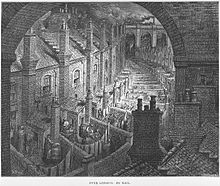
During this time living conditions during the Industrial Revolution varied from the splendour of the homes of the owners to the squalor of the lives of the workers. Poor people lived in very small houses in cramped streets.
Conditions did improve during the 19th century as public health acts were introduced covering things such as sewage, hygiene and making some boundaries upon the construction of homes. Not everybody lived in homes like these.
The Industrial Revolution created a larger middle class of professionals such as lawyers and doctors. The conditions for the poor improved over the course of the 19th century because of government and local plans which led to cities becoming cleaner places, but life had not been easy for the poor before industrialization.
 |
| Source: Google images |
Citations:
1. Wikipedia 2010, Industrial Revolution (2010), U.S., viewed 7th of October, 2010
<http://en.wikipedia.org/wiki/Industrial_Revolution>
<http://en.wikipedia.org/wiki/Industrial_Revolution>


Comments
Post a Comment